Bed Bugs in History: How Ancient Civilizations Dealt with Them
Have you ever wondered how our ancestors managed pest problems? For thousands of years, humans have shared their living spaces with tiny, persistent intruders. Fossil evidence reveals that these creatures have been our companions for over 3,500 years, dating back to ancient Egyptian times.
Despite nearly being eradicated after World War II, these pests have made a global comeback. Modern travel and pesticide resistance have fueled their resurgence, making them a widespread issue today. In the UAE, this challenge is no different, as urban living and international connections create the perfect environment for their spread.
Understanding how ancient civilizations tackled this problem can offer valuable insights. Their methods, though primitive, laid the groundwork for modern pest control strategies. By exploring their solutions, we can better address the challenges we face now.
We explore Bed Bugs in History, revealing how ancient civilizations dealt with these pests and what we can learn from their experiences.
Key Takeaways
- Bed bugs have been human companions for over 3,500 years.
- Fossil evidence traces their presence to ancient Egyptian sites.
- Modern travel patterns have contributed to their global resurgence.
- The UAE faces unique challenges in managing these pests.
- Historical solutions can inform today’s pest control strategies.
Introduction: The Persistent Problem of Bed Bugs
These tiny pests have been a constant companion to humans for centuries. They feed exclusively on blood and can survive up to 300 days without a meal. Their resilience makes them a formidable foe, even in modern times.
Infestations have surged globally, with a 71% increase reported in the U.S. between 2000 and 2005. This trend is not isolated. In the UAE, the thriving tourism economy and international transit hubs create ideal conditions for their spread.
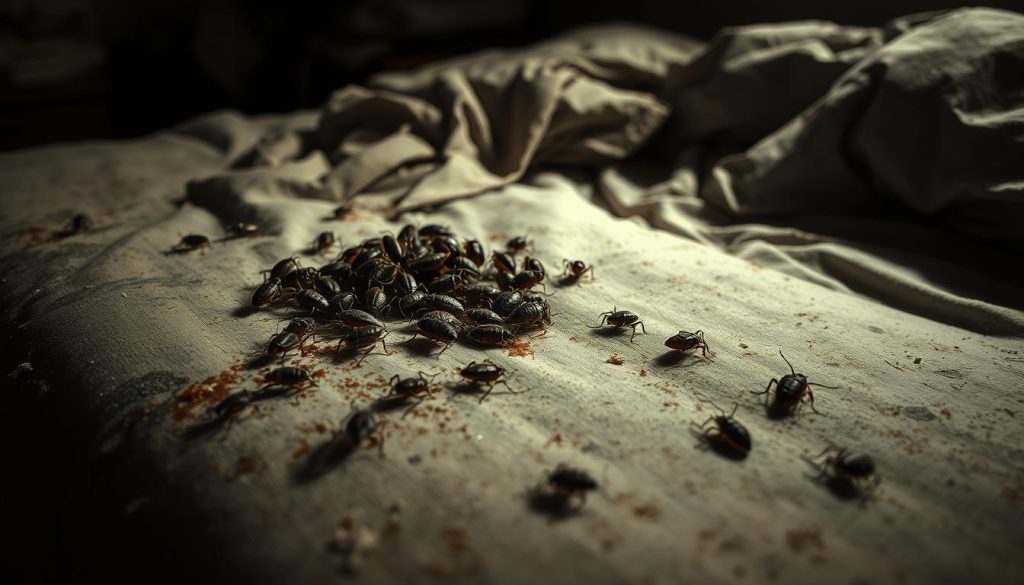
Beyond physical discomfort, these pests cause significant psychological and social stress. The fear of bites and the stigma associated with infestations can disrupt daily life. Addressing this issue requires understanding their biology and behavior.
These creatures reproduce rapidly, with females laying hundreds of eggs in their lifetime. Their ability to hide in small, hard-to-reach areas makes eradication challenging. This adaptability has allowed them to thrive across different environments.
In the UAE, luxury hotels and densely populated urban areas are particularly vulnerable. The constant flow of travelers increases the risk of introducing these pests into new spaces. Understanding these risk factors is crucial for effective management.
By exploring historical case studies, we can gain insights into how ancient civilizations tackled this problem. Their methods, though primitive, offer valuable lessons for modern pest control strategies.
Bed Bugs in Ancient Egypt: The First Recorded Encounters
Ancient Egypt holds some of the earliest evidence of human struggles with tiny invaders. These pests have been a part of our lives for over 3,500 years, as shown by discoveries in Tutankhamun-era settlements. The first mentioned records of these creatures come from hieroglyphs, where they were referred to as “night biters.”

In 2014, archaeologists uncovered fossilized remains of these pests at the Amarna site. This discovery confirmed their presence in ancient Egyptian homes. The bugs found in these excavations were remarkably preserved, offering a rare glimpse into their early history.
Fossilized Bed Bugs: A 3,500-Year-Old Problem
The Amarna findings revealed how deeply these pests were embedded in daily life. They thrived in the warm, humid climate of the Nile Valley. Their resilience made them a persistent issue, even in the ancient world.
Ancient Remedies: How Egyptians Tried to Combat Bed Bugs
Egyptians developed creative solutions to tackle this pest problem. They used herbal mixtures, including neem oil, to repel these intruders. Ash barriers were also common, as they created a physical deterrent.
Some papyrus recipes even included diatomaceous earth, a natural substance that dehydrates pests. These early methods laid the foundation for modern pest control. While not always effective, they show the ingenuity of ancient civilizations.
Interestingly, these pests were also used in medicinal rituals. They were burned and incorporated into potions believed to heal snakebites. This dual approach—combating and utilizing pests—highlights their complex relationship with humans.
By studying these ancient practices, we gain valuable insights into the enduring challenge of pest control. The Egyptians’ efforts remind us that this is a problem as old as civilization itself.
Bed Bugs in Ancient Rome and Greece: A Common Nuisance
From Rome to Athens, these tiny invaders were a shared nuisance. Both civilizations developed unique methods to combat the persistent problem of cimex lectularius, a term the Romans coined to describe these insects. Their approaches ranged from practical remedies to philosophical observations, offering a fascinating glimpse into ancient pest control.

Roman Practices: From Cimex to Medicinal Uses
The Romans were no strangers to these pests. They referred to them as cimex, a term that has persisted in scientific classifications like cimex lectularius. Roman baths, a cornerstone of daily life, became battlegrounds against these insects. Heated sand treatments were used to eliminate them, showcasing their ingenuity.
Pliny the Elder documented the use of poultices made from these insects to treat ear infections. Galen, a prominent physician, prescribed extracts from these pests for medicinal purposes. These practices highlight the dual role of these insects—both as a nuisance and a resource.
Greek Philosophy: Aristotle’s Observations on Bed Bugs
Aristotle, the famed Greek philosopher, made detailed observations about these insects in his work Historia Animalium. He described their molting process and lifecycle, providing one of the earliest scientific accounts of their behavior. His work laid the groundwork for future studies.
Unlike the Romans, the Greeks focused more on understanding these creatures rather than eradicating them. This philosophical approach contrasts with the practical methods used in Rome, yet both civilizations contributed to our knowledge of pest control.
When comparing Mediterranean methods to those of ancient Egypt, we see a blend of practicality and philosophy. While the Egyptians relied on herbal mixtures and ash barriers, the Romans and Greeks introduced heated treatments and scientific observations. These diverse approaches remind us that pest control has always been a multifaceted challenge.
Bed Bugs in Medieval Europe: A Growing Epidemic
Medieval Europe faced a growing epidemic that disrupted daily life and sparked innovative solutions. As populations grew and urban centers expanded, infestations became a widespread issue. From castles to cottages, no one was spared from the relentless bites of these tiny intruders.

In England, the problem escalated in the 16th century. Records from 1583 reveal lawsuits over infested rental properties, highlighting the severity of the issue. Even royalty wasn’t immune; Henry VIII’s bed inventory listed mercury-based treatments, a risky yet common remedy of the time.
England’s Battle with Infestations
England’s struggle with these pests was well-documented. Tudor-era court cases often involved disputes over infested homes, showing how deeply the problem affected society. Landlords faced legal consequences for failing to address the issue, a rare example of early tenant rights.
Mercury and lead were frequently used in attempts to control infestations. However, these solutions posed significant health risks. “The cure was often worse than the disease,” as one historian noted. Despite the dangers, these methods persisted for years.
Medieval Remedies: Boiling Water and Sulfur
Medieval Europe relied on a mix of practical and hazardous remedies. Boiling water was a common method to eliminate pests from bedding and furniture. Straw mattresses were often burned to prevent further spread, though this was only partially effective.
Sulfur fumigation was another popular solution. While it could kill pests, it also caused respiratory issues and even deaths. Hildegard von Bingen, a medieval scholar, recommended herbal sachets as a safer alternative. Her recipes included ingredients like lavender and rosemary, which are still used in natural pest control today.
Castle architecture also evolved to combat the problem. Thick stone walls and raised sleeping platforms were designed to reduce harborage areas. These modifications show how deeply infestations influenced daily life and even building practices.
By examining these historical methods, we gain valuable insights into the enduring challenge of pest control. While some remedies were effective, others remind us of the risks involved in tackling such a persistent problem.
Bed Bugs in Colonial America: A New World Problem
Colonial America faced its own unique challenges with tiny intruders. As settlers established homes in North America, they encountered persistent pests that thrived in their new environment. Growing populations and close living quarters made infestations a common issue.
Early American homes were particularly vulnerable. Settlers sought ways to get rid of these pests, experimenting with both natural and chemical solutions. Their efforts laid the groundwork for modern pest control methods.
Sassafras Wood and Arsenic: Early American Solutions
One of the most popular remedies was sassafras oil, derived from the bark of the sassafras tree. Native American tribes, such as the Lenape, had long used this plant for its repellent properties. Early colonists adopted this practice, and sassafras oil remains an EPA-approved repellent today.
However, not all solutions were safe. Arsenic, a toxic substance, was widely used to eliminate pests. “Arsenic was effective but deadly,” noted Benjamin Franklin in his correspondence. Overuse led to poisoning cases, highlighting the dangers of early pest control methods.
Sailing Ships and Bed Bugs: A Sailor’s Nightmare
Sailing ships were another hotspot for infestations. Ship logs from the 18th century reveal that crewmen often slept in hammocks dipped in tar to deter pests. Burning tobacco was used for fumigation, though it provided only temporary relief.
Ports like New York implemented quarantine measures to prevent the spread of infestations. Despite these efforts, the bug problem persisted, making life at sea a constant battle.
| Remedy | Effectiveness | Risks |
|---|---|---|
| Sassafras Oil | High | None |
| Arsenic | Moderate | Poisoning |
| Tar-Dipped Hammocks | Low | Skin Irritation |
| Tobacco Fumigation | Temporary | Respiratory Issues |
The 18th and 19th Centuries: Bed Bugs in the Industrial Age
The Industrial Age brought new challenges for managing pests in crowded urban spaces. As cities expanded, so did the struggle against tiny intruders. Rapid urbanization created ideal conditions for infestations, making pest control a pressing issue for people everywhere.
In Victorian England, the problem reached alarming levels. Charles Dickens’ descriptions of workhouse infestations highlighted the severity of the issue. “The air was thick with the scent of coal tar soap,” he wrote, referencing a popular remedy of the time. London’s “bed bug clubs” emerged, where neighbors shared steam treatment equipment to combat the problem collectively.
Victorian England: Bed Bugs in the Age of Industry
Coal tar soap became a household staple, advertised as a powerful solution for pest control. Despite its strong odor, it was widely used in homes and public spaces. Early steam cleaners also gained popularity, offering a more effective way to eliminate pests from furniture and bedding.
Patent records from this era reveal innovative mechanical traps designed to catch these intruders. While some were effective, others were more gimmicky than practical. These inventions reflect the growing demand for solutions in an increasingly urbanized world.
American Cities: Bed Bugs in Urban Centers
Across the Atlantic, American cities faced similar challenges. The 1897 NYC health report cited a staggering 70% infestation rate in tenement buildings. Immigrant neighborhoods, with their high population density, were particularly vulnerable.
Early vacuum prototypes were developed specifically to target pests in mattresses and furniture. These devices marked a shift toward more modern methods of control. However, their high cost limited accessibility for many people.
| Method | Effectiveness | Accessibility |
|---|---|---|
| Coal Tar Soap | Moderate | High |
| Steam Treatment | High | Moderate |
| Mechanical Traps | Low | High |
| Early Vacuums | High | Low |
By the late 19th century, the fight against pests had become a defining feature of urban life. These early efforts laid the groundwork for the advanced control methods we use today.
The 20th Century: The Rise and Fall of Bed Bugs
The 20th century marked a turning point in the battle against persistent pests. Innovations in chemistry and technology reshaped how we approached infestations. From the widespread use of DDT to the introduction of vacuum cleaners, this era saw both triumphs and challenges.
DDT and the Decline of Bed Bugs
During World War II, DDT became a game-changer in pest control. The military used it extensively in barracks to eliminate infestations. By 1946, the USDA film “The Houseguest” promoted DDT as a revolutionary solution for households.
A 1953 study revealed that 97% of U.S. hotels were free of these pests, thanks to DDT. However, the chemical’s overuse led to unintended consequences. Pediatric exposure cases raised concerns about its safety, and by 1972, bans were implemented. This led to a 500% rebound in infestations by 1980.
“The cure was effective but came with a cost,” noted a public health expert of the time.
The Vacuum Cleaner: A Silent Hero in Bed Bug Control
While pesticides dominated the scene, vacuum cleaners quietly emerged as a powerful tool. The Hoover Company developed attachments specifically designed to target pests in mattresses and furniture. These devices became essential in integrated pest management protocols.
Combining vacuuming with chemical treatments proved highly effective. However, the rise of resistance to pesticides highlighted the need for diverse strategies. Today, we continue to refine these methods to address the ongoing resurgence of infestations.
The Resurgence of Bed Bugs in the 21st Century
In the 21st century, we face a renewed challenge with an old adversary. Despite advancements in technology and pest control, these tiny intruders have made a significant comeback. The reasons for this resurgence are complex, involving global travel, urbanization, and evolving resistance to pesticides.
Global Travel and the Spread of Bed Bugs
Global travel has played a major role in the spread of these pests. Airports, such as JFK in New York, intercept over 4,000 cases annually. The UAE has also seen a rise in infestations, with Dubai Airport implementing thermal scanners to detect and prevent their spread.
Luxury hotels, particularly in developed countries, have faced lawsuits due to infestations. This has led to a 300% increase in pest control budgets since 2010. The constant movement of people and goods creates ideal conditions for these pests to thrive.
Pesticide Resistance: A Modern Challenge
Another significant issue is pesticide resistance. Neonicotinoid resistance has been confirmed in 48 states across the United States. This has forced us to rethink traditional pest control methods and explore innovative solutions.
CRISPR research is now focusing on metabolic resistance, offering hope for more effective treatments. Additionally, suitcase heater devices are being evaluated as a preventive measure. These advancements highlight the need for a multifaceted approach to pest management.
“The battle against these pests is far from over. We must adapt and innovate to stay ahead,” says a leading entomologist.
In the UAE, heat treatment case studies have shown promising results. By combining traditional methods with modern technology, we can better address this persistent problem. The lessons learned from these efforts will shape the future of pest control.
Ancient vs. Modern Methods: What Can We Learn?
Throughout history, humans have sought ways to combat persistent pests, blending ancient wisdom with modern innovation. From Egyptian ash barriers to Roman heat treatments, early civilizations laid the groundwork for today’s pest control strategies. Now, with advanced technologies and integrated approaches, we can build on their legacy to tackle infestations more effectively.
Natural Remedies: Are Ancient Practices Still Effective?
Ancient methods often relied on natural solutions. Egyptians used ash barriers to deter pests, while Ayurvedic traditions applied neem oil for its repellent properties. These practices are still relevant today. For example, diatomaceous earth, a natural desiccant, achieves a 98% mortality rate when combined with silica gel, according to an NIH study.
Modern desiccants, like those recommended by Dubai Municipality, build on these principles. They are more refined but share the same goal: dehydrating pests to eliminate them. This blend of old and new shows that natural remedies can still play a vital role in pest management.
Integrated Pest Management: A Modern Solution
Today, we rely on Integrated Pest Management (IPM) to address infestations. This approach combines multiple strategies, such as heat treatments, desiccants, and chemical solutions, for maximum effectiveness. For instance, Roman heat methods have evolved into modern thermal chambers, which are widely used in the UAE.
IPM certification programs in the UAE emphasize the importance of combining traditional and modern techniques. Steam treatments, paired with desiccants, are now standard protocols in many areas. This holistic approach ensures that we stay ahead of evolving pest challenges.
- Egyptian ash barriers vs. modern desiccants: Both aim to dehydrate pests, but modern methods are more precise.
- Roman heat treatments vs. thermal chambers: Ancient practices inspired today’s advanced heat-based solutions.
- Ayurvedic neem oil: Still used in natural pest control, proving the enduring value of ancient remedies.
- UAE’s IPM programs: A model for integrating traditional and modern methods.
By learning from the past and embracing innovation, we can create effective strategies to manage pest problems in our world today.
Bed Bugs in History: Lessons for the Future
Looking back at the past, we can uncover valuable lessons for managing pest challenges today. Genomic studies comparing ancient and modern specimens reveal how these creatures have adapted over time. Understanding these changes helps us develop more effective strategies for the future.
Climate change is another factor shaping the problem. Rising temperatures and shifting weather patterns create favorable conditions for infestations. Predictions suggest that populations of these pests could increase in urban areas, making proactive measures essential.
Innovative technologies like blockchain luggage tagging systems are being evaluated to prevent the spread of infestations. These systems track luggage in real-time, reducing the risk of introducing pests into new areas. Such advancements highlight the importance of combining technology with traditional methods.
Preserving pesticide formulas in museum-grade conditions ensures that we retain access to historical solutions. This approach allows us to study and refine past remedies, adapting them to modern challenges. It’s a way of honoring the ingenuity of earlier generations while addressing current needs.
Finally, advocating for global monitoring networks can help us stay ahead of infestations. The 2023 WHO report warns of pan-resistant strains, emphasizing the need for collaborative efforts. AI monitoring systems, achieving 94% early detection in UAE trials, demonstrate the potential of such networks.
- Genomic studies reveal how pests have evolved over time.
- Climate change is predicted to increase infestations in urban areas.
- Blockchain tagging systems reduce the spread of pests through luggage.
- Museum-grade preservation ensures access to historical pesticide formulas.
- Global monitoring networks, powered by AI, offer early detection solutions.
Conclusion: The Enduring Challenge of Bed Bugs
The struggle against these persistent pests spans millennia, yet their resilience continues to challenge us today. Over time, they have adapted to survive, making control efforts increasingly complex. In the UAE, where urban living and global travel create unique vulnerabilities, addressing infestations requires both historical awareness and modern innovation.
With average treatment costs exceeding AED 15,000, the financial impact is significant. Globally, the market for solutions is projected to reach $38 billion by 2029, reflecting the scale of the problem. We must learn from the past, leveraging ancient methods alongside advanced technologies to stay ahead.
Complacency is not an option. International research consortiums and collaborative efforts are essential to combat this enduring challenge. By combining historical insights with cutting-edge strategies, we can build a future where these pests no longer disrupt our lives.