
The Science Behind Ant Colonies Surviving in UAE’s Desert Heat
We explore how tiny creatures thrive where few animals can. In scorching environments, these insects show amazing resilience. Their survival tactics are both simple and brilliant.
Some species, like Cataglyphis bombycina, have special adaptations. They withstand extreme conditions that would challenge most life forms. Researchers study their unique strategies with great interest.
Understanding these mechanisms helps experts like Super Dream Pest Control & Cleaning Services UAE. They manage infestations even in harsh climates. This knowledge proves vital for effective solutions.
Learn about the Science Behind Ant Colonies Surviving in UAE’s Desert Heat with our comprehensive Ultimate Guide. We delve into their survival tactics.
We will look at key factors enabling their success. From body temperature control to efficient foraging, nature offers incredible lessons. These insights benefit both science and practical applications.
Key Takeaways
- Ants possess remarkable adaptations for extreme heat survival
- Silver ants demonstrate unique physical and behavioral strategies
- Desert temperatures create challenging conditions for most species
- Research provides valuable insights for pest control professionals
- Natural systems offer inspiration for human technological solutions
- Climate change impacts how species adapt to their environment
- Professional services use this knowledge for effective ant management
Understanding the Extreme Desert Challenge for Ants
Few environments test animal limits like the Emirates’ scorching sands. These tiny insects face conditions that would overwhelm most creatures. Their survival depends on remarkable biological innovations.
The Inhospitable Environment of the UAE Desert
Surface temperatures here regularly exceed 70°C (158°F). This creates an oven-like landscape. Most animals cannot function in such extreme heat.
Arid conditions add another layer of difficulty. Water sources remain scarce for months. Food becomes equally challenging to find.

Researchers note these factors combine uniquely. Natalia de Souza Araujo’s work shows how Cataglyphis bombycina evolved specifically for this environment. Their adaptations represent nature’s ingenious solutions.
Why Forage During the Hottest Part of the Day?
These ants brave peak heat for strategic reasons. Competition disappears when predators seek shade. They scavenge insects that succumbed to temperatures.
Their foraging window shrinks to mere minutes. They must locate food and return before overheating. This demands incredible precision and speed.
“Their efficiency in extreme conditions reveals evolutionary mastery”
Radiative cooling helps manage body temperature. Clear skies allow heat dissipation between bursts of activity. Special hairs reflect sunlight rather than absorb it.
Companies like Super Dream Pest Control & Cleaning Services UAE study these patterns. Understanding foraging behavior helps develop effective management strategies. They apply this knowledge to address infestations in harsh climates.
Climate change may alter these delicate systems. Rising temperatures could shrink already brief activity windows. This makes research more urgent for ecological and practical reasons.
We see how desert conditions shape every aspect of ant life. From hunting strategies to colony organization, heat dictates their existence. These insights benefit both science and pest control professionals.
Remarkable Adaptations for Desert Survival
Desert ants possess incredible tools for thriving in harsh environments. Their survival depends on three key areas working together perfectly.
Physical features, smart behaviors, and molecular defenses create a complete survival system. Each element plays a vital role in their daily lives.
Morphological Marvels: Silver Hairs and Long Legs
Silver ants show amazing physical adaptations. Their bodies feature special prism-like hairs that reflect sunlight.
These unique hairs act like tiny mirrors. They bounce solar radiation away instead of absorbing it.
Long legs provide another advantage. They keep the insect’s body elevated above hot surfaces.
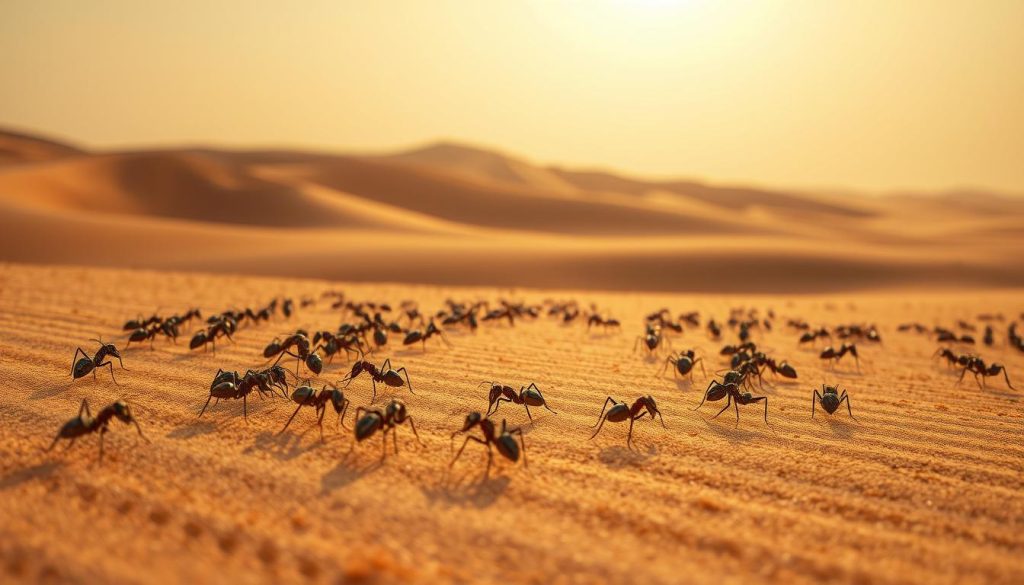
This combination proves extremely effective. It helps maintain safe body temperature even during peak heat hours.
Researchers continue studying these features. Their work reveals nature’s brilliant solutions to extreme conditions.
Behavioral Strategies: Speed and Precision Navigation
These insects demonstrate incredible speed when foraging. They can sprint up to seventy times their body length per second.
Such rapid movement minimizes heat exposure. It allows quick food gathering during brief safe windows.
Navigation skills are equally impressive. They use celestial cues and step counting to find the shortest path home.
This precision ensures maximum efficiency. Every second counts in their dangerous environment.
Companies like Super Dream Pest Control & Cleaning Services UAE study these patterns. Understanding ant behavior helps develop targeted treatment methods.
Molecular Mechanisms: Heat Shock Proteins and Cellular Defense
At the cellular level, special proteins provide crucial protection. Heat shock proteins stabilize other proteins during thermal stress.
This molecular defense system prevents cellular damage. It allows normal functioning under extreme temperature conditions.
“Their cellular adaptations represent evolutionary perfection for desert survival”
Other factors like cuticular hydrocarbons also contribute. They help reduce water loss and provide additional thermal protection.
Research continues uncovering new molecular adaptations. Each discovery reveals more about their amazing survival capabilities.
The interplay between these systems creates a robust survival strategy. Physical features, behaviors, and molecular defenses work in perfect harmony.
This knowledge helps pest control professionals develop more effective solutions. It also inspires human innovations in cooling technologies.
The Science Behind Ant Colonies and a Warming World
Global warming presents new challenges for desert-adapted insects. Even species with remarkable heat tolerance face unprecedented thermal stress. Researchers study how rising temperatures affect their survival strategies.
We examine climate impacts on these sophisticated social insects. Their responses offer insights into ecological resilience. This knowledge helps predict broader environmental changes.
How Climate Change Poses a Threat to Ant Populations
Rising temperatures exceed optimal ranges for many species. Most ants function best between 25-35°C. Beyond this range, foraging efficiency declines dramatically.
Metabolic stress becomes a serious concern. Insects must expend more energy for basic functions. Colony survival becomes threatened over time.
Some species attempt geographic shifts to cooler areas. Others modify nesting behaviors by digging deeper. These strategies have limitations due to short lifecycles.

Multi-generational changes require significant time. Rapid temperature increases outpace evolutionary adaptation. This creates survival challenges for entire colonies.
Lessons from Ants on Evolutionary Adaptation
Independent evolution of heat tolerance appears in multiple genera. This demonstrates nature’s remarkable plasticity. Different species develop unique solutions to similar problems.
Gene expression studies reveal molecular responses to thermal stress. Natalia de Souza Araujo’s research shows how Cataglyphis bombycina manages extreme conditions. These findings help predict species survival in warming environments.
“Molecular adaptations provide crucial insights into thermal resilience mechanisms”
Ecosystem impacts extend beyond single species. Mismatches in timing between foraging and food availability disrupt ecological balance. These changes have cascading effects throughout desert environments.
| Temperature Range | Foraging Efficiency | Colony Response | Adaptation Timeline |
|---|---|---|---|
| 25-35°C (Optimal) | Peak performance | Normal growth | Immediate |
| 36-45°C (Stress) | Reduced activity | Limited foraging | Weeks to months |
| 46°C+ (Critical) | Nearly absent | Colony decline | Multi-generational |
Practical implications for the UAE are significant. Companies like Super Dream Pest Control & Cleaning Services UAE adapt their strategies. They handle changing infestation patterns caused by climate shifts.
Understanding these dynamics proves crucial for conservation. Ants serve as important environmental health indicators. Their responses help guide effective pest management approaches.
Human activities must evolve alongside these changes. Science-based approaches mitigate negative impacts on biodiversity. Research continues to inform global conservation efforts.
Conclusion: Marvels of Nature and Modern Solutions
Nature’s engineering shows incredible efficiency. Desert species demonstrate remarkable adaptations for extreme conditions. Their survival combines physical, behavioral, and molecular strategies.
Reflective hairs help manage body temperature. Special proteins protect cells during thermal stress. These systems maintain colony function despite harsh environments.
Research provides valuable insights for practical applications. Companies like Super Dream Pest Control & Cleaning Services UAE use this knowledge. They develop effective solutions based on scientific understanding.
These tiny insects inspire human innovation. Their adaptations offer lessons for cooling technologies. Continued study helps address climate challenges.
We gain appreciation for nature’s complexity. These insights benefit both science and daily life. Understanding these mechanisms proves essential for sustainable solutions.